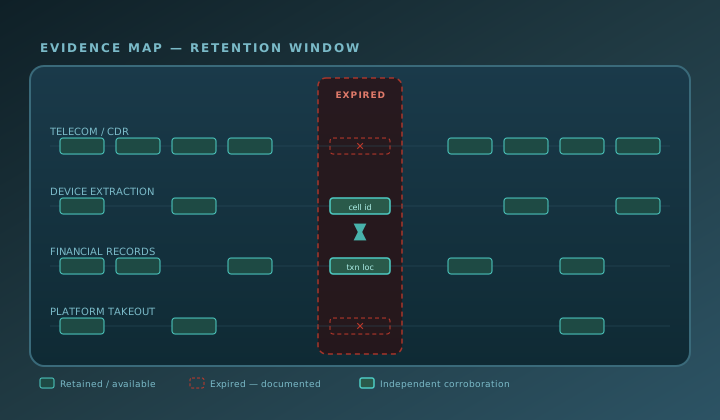
Financial crime cases rarely arrive with a complete record set. Retention windows close before the subpoena is served. A carrier decommissions a system. A bank merges and the legacy records migrate into a format no one can read. A cloud platform returns a partial export because the account was deactivated eighteen months ago. The investigator who waits for complete evidence before beginning analysis is waiting for something that will not come.
The question is not whether records will be missing. They will. The question is whether the team has a methodology for working around the gaps rather than treating each one as an obstacle that stops the case.
Why retention gaps create more than evidentiary problems
The legal frameworks governing data retention were not written with financial crime investigations in mind. Telecom carriers typically hold CDR data for twelve to eighteen months, sometimes less for tower-level geolocation. Financial institutions retain transaction records for five to seven years in most jurisdictions, but that window often does not include the account metadata, the login activity, or the device identifiers that investigators actually need for entity resolution. Platform data can disappear entirely when an account is deleted or when a takeout request arrives after the platform's rolling retention window has passed.
When records expire, the investigator loses more than a data source. They lose the corroborating layer that ties other records together. A CDR that confirms a subject's location during a transaction no longer exists. The analysis can still be run on the financial records that survived, but the timeline has a hole in it that cannot be explained away and can be exploited in cross-examination. The gap is not just an evidentiary absence. It is a structural weakness in the case narrative.
What the available evidence can still establish
Missing records shift the analytical focus from direct proof to circumstantial reconstruction, which is more demanding but not less valid. Courts accept circumstantial evidence. The challenge is building enough corroborating density around the gap that its absence does not undermine the parts of the case that are well-supported.
The first step is identifying what the missing record would have established, then asking which other sources can establish the same fact independently. If the tower records for a specific date are gone, device extraction data may show which cell network the phone was connected to. If that is also unavailable, financial records may show a transaction in that location. Layering independent sources around the gap does not fill it — but it demonstrates that the investigative conclusion does not rest on the missing data alone.
The second step is documenting the gap explicitly. An unexplained absence in the evidence record looks like an oversight. An explained absence — here is what we requested, here is what the carrier retained, here is the legal response confirming the window had closed — looks like thorough methodology. The investigator who acknowledges what is missing and explains how they reached their conclusions without it is in a much stronger position than one whose file simply has no telecom data for a two-month window.
Where the workflow breaks down in practice
The most common failure mode is not that investigators cannot work around missing records. It is that they discover the gaps too late. The subpoena goes out at month three of a six-month investigation. The carrier responds that records older than twelve months are not available. The team has already built an analytical model that depends on data for month two. Walking that model back means rebuilding substantial parts of the case.
Teams that build the evidence map early — before deep analysis begins — identify retention risk at the point where it is still actionable. If the team knows in week two that carrier records for a specific subject window are about to expire, they can prioritize that request before the window closes. If they discover it in month four, the option is gone. The same logic applies to platform data, financial records with unusual retention policies, and any evidence type where the clock is running independently of the investigation timeline.
The second failure mode is treating a gap in records as a gap in the case. An investigator who builds an analytical conclusion entirely around sources that do survive, and documents that methodology clearly, has done the job. The case does not require every record to exist. It requires that the evidence that does exist be handled in a way that holds up.
What the team needs to run this methodology consistently
Working around missing records requires two things in parallel. First, a complete inventory of what was requested, what was received, and what was confirmed unavailable — maintained as a live document throughout the investigation, not reconstructed at the end. Second, a case model that treats the available evidence as the authoritative record and flags where gaps exist rather than leaving them implicit.
Most investigation workflows capture what was found. They do not consistently capture what was not found and why. That distinction matters at prosecution. A file that shows the team exhausted the available sources, documented what expired, and built its conclusions on what survived is a file that can be defended. A file with unexplained silences in the record is one that cannot.