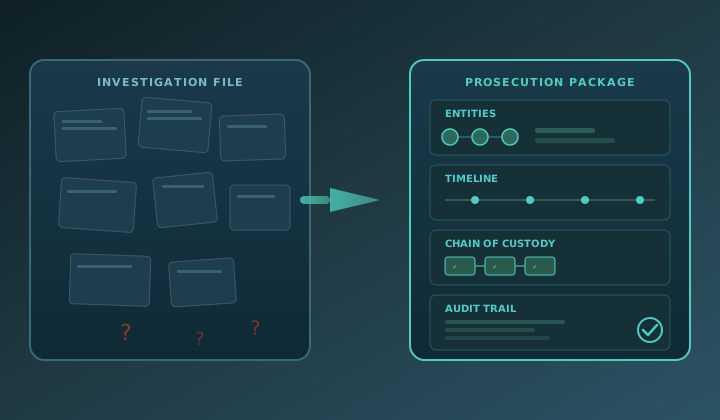
When an investigation closes and the referral goes to a prosecutor, the investigative team hands over a file. That file contains the evidence they gathered, the analysis they ran, and the conclusions they reached. What it rarely contains is a version of that work the prosecutor can independently navigate, verify, and present to a court without calling the analyst back in to explain it. The handoff creates a new problem. The case that was clear in the analyst's mental model becomes a set of folders and spreadsheets that someone else has to reconstruct from scratch.
Why the case file does not speak for itself
Investigation teams work in the same environment over weeks or months. They hold the entity relationships, the timeline logic, and the analytical decisions in their heads because they were present when each piece arrived. The case file reflects the outputs of that process, not the process itself. A bank statement that appears in a folder as a scanned PDF does not tell the prosecutor why it matters, which accounts it connects to, or what anomaly the investigator noticed on page seven. The analyst knows. The file does not.
The problem compounds across evidence types. Financial records, communications data, device extractions, and open-source evidence all use different identifiers. In a well-run investigation those identifiers have been normalized into a shared entity model. In the referral package they are often separate again, segregated by source type and labeled with internal reference numbers that mean nothing outside the original team. A prosecutor building their own case theory from that material is effectively re-running the investigation with incomplete context.
What prosecutors actually need from the file
A prosecution-ready package needs to answer three questions without requiring the investigator to be in the room. First, who are the key entities and how did you identify them. Second, what is the sequence of events and which records establish each step. Third, where does each piece of evidence come from, what legal authority was used to obtain it, and who handled it between collection and delivery.
The third question is where most investigation files are weakest. Chain of custody documentation is often maintained for individual items but not across the case as a whole. If a prosecutor needs to explain to a defense attorney how a specific cell tower record was obtained, normalized, and connected to a specific defendant, that explanation has to be derivable from the file. When it is not, the analyst testifies. When the analyst testifies without a documented audit trail behind them, the methodology becomes the target.
Where the documentation gap creates real risk
The most common failure mode is not missing evidence. It is evidence that exists in the file but cannot be located or explained quickly under cross-examination. A financial record that took the analyst six hours to extract meaning from takes six hours to explain to a jury if the work is not documented. Defense counsel does not need to disprove the evidence. They need to introduce enough procedural uncertainty that the trier of fact cannot follow the argument.
Investigators who have worked cases through to conviction know that the prosecution preparation phase is where the analytical work either holds or starts to unravel. The timeline that was clear to the team looks fragile when it is presented as a series of disconnected exports with no visible thread. The entity relationships that drove the case strategy look circumstantial when the only person who can explain them is the analyst who built them.
What changes when the case is built for handoff from the start
Teams that build for prosecution from day one treat documentation as part of the analytical workflow, not as a reporting step at the end. Every connection between identifiers is recorded when it is made. Every analytical decision — why a record was included, why a time window was selected, why a particular entity was linked — exists in the case model alongside the evidence it explains. When the referral goes to prosecution, the file contains not just what was found but how it was found and why each step was taken.
That structure is what allows a prosecutor to pick up the case without a lengthy handover meeting, what allows a second analyst to verify the work independently, and what allows the methodology to survive cross-examination because it does not depend on memory. The investigation that is ready for prosecution is not one that gathered more evidence. It is one that built the case in a form that holds up when the original team is no longer the audience.