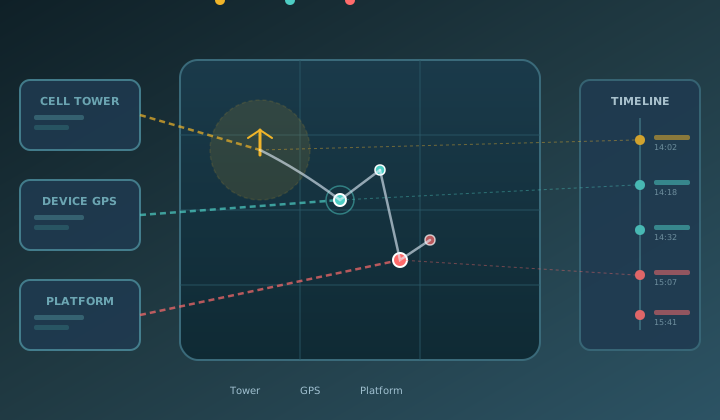
Every serious financial crime or fraud investigation eventually touches location. The suspect's phone placed them at the branch. The tower data puts them in the city. The banking app logs a login from a device 400 miles away. On their own, none of those records means much. Together, they either confirm the timeline or break it.
The problem is that location evidence almost never arrives in one place or one format. Cell tower records come from the carrier in one structure. GPS coordinates come out of a device extraction in another. Location history from a Google or Apple takeout uses a third schema entirely, with its own accuracy bands and timestamp conventions. Each source is internally consistent. Making them consistent with each other is the work.
Why location data fragments across sources
The fragmentation is structural, not accidental. Carriers record tower associations for billing and network management, not for investigations. The precision is rough — a cell tower sector covers a wide area in a city and a much wider area in a rural zone — and the timestamps reflect network events, not verified location fixes. Device GPS logs are far more precise, but they only exist when an app requested location and the device cooperated. Platform takeouts from social media or navigation services often contain the most granular location history, but that data is tied to account activity, not to physical presence, and the account may have been accessed from a shared or borrowed device.
Investigators who treat any single source as the location record miss what the other sources add. The tower record establishes presence in a general zone. The device GPS, if it exists, pins the fix to within meters. The platform history shows whether the account was active at that location or somewhere else at the same time. When all three are in the picture, the movement narrative either holds or it exposes a contradiction worth pursuing.
Where the manual process breaks down
The manual workflow for building a location narrative means exporting each source into a spreadsheet, converting timestamps to a common timezone, normalizing coordinate formats, and then trying to plot or sequence events across all three data types. That process works for a single device and a short timeframe. It stops working when the case involves multiple suspects, multiple devices, and a timeline that spans weeks.
The compounding problem is that location data points do not live in isolation. A GPS fix at 14:32 is only meaningful if you know what else was happening at 14:32 — the phone call that started, the bank transaction that completed, the message that was sent. Building that picture in separate spreadsheets means the analyst is mentally holding the cross-source alignment together rather than seeing it. Connections that would be obvious in a unified view get missed because the analyst has to flip between files to find them.
Location data is not a secondary source. It is often the thread that ties the rest of the file together.
What a unified location review changes
When location evidence from all sources is normalized and loaded into the same case model as the financial records and communications data, the timeline builds itself as each new source is added. A tower ping that looked unremarkable on its own now sits next to the wire transfer that happened in the same window. A gap in device GPS that the analyst almost missed turns out to correspond to a three-hour block where no calls were made and no transactions occurred — a pattern worth noting.
The analyst's job shifts from assembly to interpretation. Instead of spending time moving data between formats, they are asking whether the movement pattern is consistent with the stated account of events, whether any entity's location history places them in contact with another entity the case had not yet connected, and whether the timing of location events tracks against the financial activity. Those are investigative questions. They can only be asked once the location picture is stable.
What to test in practice
The right test is whether a full movement narrative — covering device GPS, tower records, and platform location history for a single subject across a two-week window — can be assembled and displayed against the financial and communications timeline without a manual normalization step. If that view is available within minutes of loading the source files, the location layer adds to the case instead of adding to the workload. If it requires a day of spreadsheet work first, the location evidence is often reviewed in isolation or not reviewed at all.
Investigators who build the location narrative alongside the financial and communications picture catch contradictions earlier and build timelines that hold up under cross-examination. Location data is not a secondary source. It is often the thread that ties the rest of the file together.