A modern handset extraction routinely contains hours of video. Some of it was recorded on the device, some was received in chats, and a good deal was forwarded from channels the subject follows. Photos get reviewed because a reviewer can scan a grid of thumbnails in minutes. Video does not scan. Ten minutes of footage takes ten minutes to watch, and on a case with three handsets that adds up to days nobody has.
So video tends to be opened only when something else points at it. That works when the lead comes first. It fails when the footage is the lead, which is more often than units assume.
Why video is the evidence left unreviewed
The problem is not the quality of the material. Handset video is often clearer than the stills, because people film what they want to show someone. A vehicle filmed from a driver's seat shows its plate. A walk through a property shows its layout, the boxes in the corner and the people present. The issue is that this information is locked in time. It exists only as frames, and frames are not searchable until something reads them.
Reviewing by sampling, such as the first few seconds of each clip or a frame every minute, misses most of it. The plate is visible for two seconds in the middle. The second person enters at the end.
From footage to objects
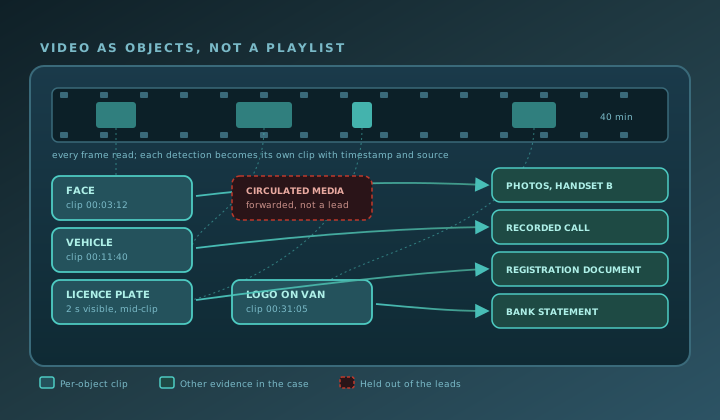
The useful change is to stop treating a video as a single item and start treating it as a collection of the things that appear in it. Every frame is read. Faces, vehicles, licence plates, logos, weapons and text on screen are detected and tracked across the frames they appear in. Each one becomes its own short clip, with the timestamp and the source video attached.
A forty-minute video then stops being an unwatched file and becomes, say, three faces, two vehicles, one readable plate and a shop sign. Each of those can be reviewed in seconds, and each can be compared with everything else in the case.
Where the value comes from
Detection on its own produces a list. The value comes from correlation. A plate read from a clip on one handset matches a registration in a seized document and a vehicle described in a recorded call. A face in a clip matches a cluster of photos from a different device, linking two subjects who never appear together in a still. A logo on a van matches a company named in a bank statement. The analyst did not have to think of any of those comparisons. The case made them.
Background detail matters here as much as it does with photos. The red container behind the person filming, or the storefront visible through a window, can tie a clip to a location named in a chat a week earlier. These are the links an analyst would only make by remembering an incidental detail from footage they never had time to watch.
What still needs an investigator
None of this removes the review step, and some parts need more care than they do for stills. A partial or motion-blurred plate is a candidate, not a read, and should be treated as one until it is confirmed against the frame. Face matches across video are a candidate set in the same way face clusters across photos are, with the same caution for poor lighting and for under-represented groups.
Provenance needs particular attention. A clip recorded on the device says something about where its owner was. The same clip received in a group chat says only that someone sent it. Widely circulated media, such as news footage, viral clips and broadcast recordings, should be recognised as such and kept out of the leads, or it will produce confident links between people who simply follow the same channels.
Handled that way, video stops being the part of the extraction that is noted in the report as "not reviewed". It becomes one more source that the rest of the case can be checked against.