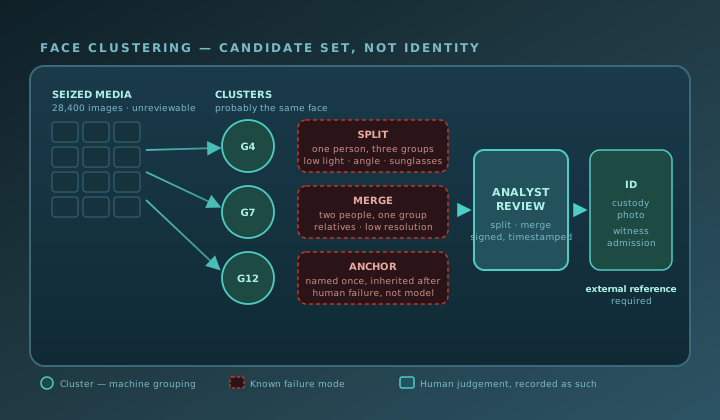
A phone seized in a serious case routinely carries between five and forty thousand images. Camera roll, downloads, cached media from four messaging apps, screenshots, thumbnails of things that were deleted. Nobody reviews all of it. Historically the team reviewed a sample, prioritised by date range or by album, and accepted that anything outside the sample was not going to be found.
Face clustering changes that arithmetic. Group every detected face by visual similarity and an analyst can move through the set by person instead of by file, which turns an unreviewable pile into a few hundred groups that a human can actually look at. On the cases where it works, it is one of the largest single time savings available in digital forensics.
It also produces findings that read as far stronger than they are, and the gap between what the technique establishes and what a report often claims is where cases get damaged.
Clustering and identification are different claims
Clustering says these images probably contain the same person. It makes no claim about who that person is. Identification says this person is the named individual, and it requires something external: a custody photo, a passport image, a witness who recognises them, an admission.
Written down that distinction is obvious. In a case file it collapses constantly, because the analyst who built the cluster knows perfectly well who is in it. The subject's face is in group seven, so group seven becomes the subject's group, and the report says the subject appears in fourteen images with a second individual. What the system established was that fourteen images contain a recurring face. That the face belongs to the subject was a human judgement, and it belongs in the file as a human judgement with a stated basis.
The consequence of blurring this is that a defence challenge to the identification lands on the whole finding. If the report presents machine output as the source of the identification, the argument becomes a fight about algorithmic reliability that the prosecution does not need to be having. If the report says the cluster grouped the images and a named investigator identified the individual by comparison against a custody photo, the identification stands or falls on the comparison, which is ordinary evidence with an ordinary answer.
Where clustering quietly gets it wrong
The technique fails in patterns, and knowing the patterns is most of what protects an analyst from over-reading a group.
It splits. The same person appears in three separate clusters because one set of images was shot in low light, one at a sharp angle, and one with sunglasses. An analyst who assumes one cluster equals one person concludes the subject appears in nine photographs when the real number is thirty-one, and the frequency argument in the report is wrong in the direction that undercounts.
It merges. Two people of similar appearance, particularly relatives, particularly at low image resolution, land in one group. Every conclusion drawn about that group is now a conclusion about two people treated as one, and if both are in the case the merge can invent a relationship that never existed.
It reproduces its training. Accuracy is not uniform across demographics, and the direction of the error is not random. Any team using this on real casework needs to know how the model behaves on the populations their cases actually involve, and needs to treat a cluster from an under-represented group as a weaker starting point rather than an equally strong one.
It anchors. Once an analyst has named a cluster, later images that arrive in it inherit the name without being examined as closely as the first ones were. This is a human failure rather than a model failure, and it is the one most likely to survive into a report unchallenged.
What the technique is genuinely good for
Read as triage rather than proof, clustering earns its place. It surfaces the person who appears across two devices seized from different suspects, which is a lead an analyst would probably never have found by manual review. It shows that an individual who claims no contact with a co-defendant appears alongside them in images spanning two years. It finds the sixteen photographs of the same location that establish a pattern of presence.
In every one of those cases, the value is that a human was pointed at the right images. The finding is what the human then established by looking at them: the timestamps, the surrounding context, the corroborating message thread, the location metadata. Clustering shortened the search. It did not produce the conclusion.
The best framing an analyst can carry into this work is that face clustering is a query, not an answer. It returns a candidate set. The candidate set is where the investigation starts.
Deploying it lawfully and documenting it properly
Biometric processing carries obligations that ordinary image review does not, and they vary by jurisdiction more than most other parts of the toolchain. Some agencies can run facial analysis on lawfully seized material as a matter of routine. Others need specific authorisation per case, and some cannot use it at all for certain categories of investigation. This is a per-deployment legal question, which is why the capability needs to be switchable rather than baked in.
Two properties matter operationally. The processing has to run locally, because sending images from a live criminal investigation to an external service creates a transfer that is difficult to justify and frequently prohibited outright. And the clustering has to be reviewable: an analyst should be able to open a group, see every image in it, split it, merge it, and have those corrections recorded as analyst actions with an author and a timestamp.
That last property is what makes the technique defensible. A cluster that a named analyst reviewed, corrected, and signed off is a piece of human analytical work supported by a tool. A cluster that arrived in a report untouched is a machine assertion the prosecution will be asked to justify. The difference costs a few minutes per group during review, and it is the difference between a finding that holds and a finding that has to be withdrawn.