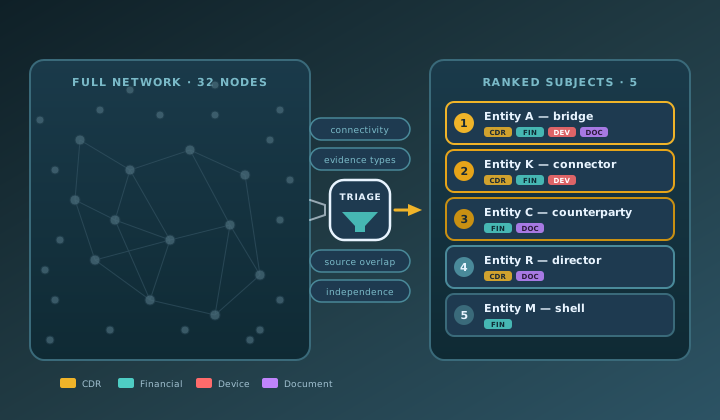
Financial crime investigations rarely arrive with a clean subject list. A single suspicious transaction flags an account. The account connects to a corporate entity. The entity shares a director with two others. One of those others has counterparties in three jurisdictions. By the time the initial network is mapped, the team is looking at dozens of nodes and no obvious place to start.
That volume is not a sign that the investigation is working. It is often the point where it stalls. Every node added without a triage framework makes the next decision harder, not easier.
Why the network keeps growing
The growth is structural. Modern financial crime is designed to diffuse risk across many accounts, entities, and jurisdictions. Each layer looks unremarkable on its own. The pattern only becomes visible at the level of relationships. So investigators have to build the full network before they can see what matters, which means they spend significant time on nodes that will eventually turn out to be noise.
The problem is that building a network and prioritizing within it are two different workflows, and most teams conflate them. They keep adding nodes because the next connection might be the important one. The network expands. The subject list grows. The time available to investigate each node shrinks.
Where triage usually fails
Most triage decisions in network investigations happen informally. A senior investigator makes a judgment call. A team huddles and agrees to focus on two or three nodes. That judgment is often correct, but it is not defensible and it does not survive a handoff. When a case transfers between teams, or reaches prosecution, the reasoning behind the subject selection is not in the file.
The other failure mode is over-indexing on transaction volume. Teams prioritize the nodes that moved the most money because that is the metric available to them. But the most valuable nodes in a financial crime network are often not the highest-volume ones. They are the connectors: the accounts or entities that bridge otherwise separate clusters. High volume is visible. High connectivity is not, unless the full network picture is already built and being reviewed structurally.
The subject list is not an output of the investigation. It is a working document that should get sharper as evidence accumulates.
What a workable triage model requires
A workable triage model requires two things that most investigation workflows do not keep in the same place: a complete network view and the underlying evidence for each node. Without the network view, the team cannot see connectivity. Without the underlying evidence, every prioritization decision is a guess about what a deeper review would actually find.
The strongest teams run a lightweight structural review before committing resources to any node. They look at how many distinct connections a node has, how many evidence types touch it, and whether it appears across source types that were collected independently. An entity that shows up in a CDR, a financial record, and a device extraction was not just a counterparty in one channel. That convergence is meaningful before a single document has been read in depth.
What to test in practice
The right test is whether the team can take a network with thirty or more nodes and identify the five or six that warrant detailed review without manually cross-referencing every source. That workflow should produce a ranked subject list that is tied to evidence, not to analyst intuition alone, and that a second team could reconstruct from the case file without a verbal briefing.
Teams that solve the triage problem early spend their investigative hours on the nodes that matter. Teams that skip it spend those hours evenly across a network that is mostly noise. The subject list is not an output of the investigation. It is a working document that should get sharper as evidence accumulates, and it should always be traceable back to the connections that justified it.